The Year of the Roth
By Terry Coxon
Created 29 Jul 2010
Until 2010 arrived, you couldn't have a Roth IRA if your income exceeded certain limits. That restriction is gone. Now anyone with a traditional IRA can convert it to a Roth. But should you?
Background
Roth or traditional, the central advantage of an IRA is tax deferral. Earnings accumulate and compound free of current tax, so the total value grows faster.
An IRA is fed by annual contributions made out of employment income (salary, wages, and fees). With a traditional IRA, the employment income you contribute escapes current tax. Tax time for the contributions and their earnings comes when you withdraw the money. With a Roth IRA, you pay tax on the income you contribute, but the contributions and earnings eventually can be withdrawn tax-free (provided the Roth is at least five years old when you take the money out).
The ceiling on contributions to either type of IRA is $5,000 per year ($6,000 if you've had a 50th birthday party).
Two other age milestones apply. Withdrawals you make before the year you reach age 59½ are subject to a 10% excise tax. And with a traditional IRA (but not a Roth), you must begin making "Required Minimum Distributions" when you reach age 70½. The question of whether to convert a traditional IRA to a Roth isn't simple. Even so, for most readers the answer turns out to be an emphatic YES.
A good way, perhaps the best way, to cut through the complexity and discover why the YES is so loud and clear is to imagine you’re starting from scratch. If you were just beginning to build an IRA, and if the rules would allow you to choose between making a deductible contribution to a traditional IRA or a non-deductible contribution to a Roth IRA, which would be better?
Tax Rates
A traditional IRA is a holding tank for taxable income. A Roth is a reservoir of tax-free income. Both give you the benefit of tax-free compounding.
Assume, for the sake of simplicity, that you are going to cash out your entire IRA when you reach age 70½. In that case, the choice between contributing to a traditional IRA or to a Roth is nothing more than a bet on tax rates. If your tax rate goes up, the Roth will give you more after-tax spendable cash when you reach age 70½. If your tax rate goes down, contributing to a Roth will turn out to have been a mistake. If your tax rate holds steady, your decision won't matter.
A simple example illustrates the last point. Suppose that:
You are 40 years old.
You have $5,000 of pre-tax employment income to contribute to an IRA
The IRA will earn 8% per year.
You are and always will be in a 40% tax bracket.
If you contribute to a traditional IRA, it will be worth $50,313 when you reach age 70½, but after paying tax on the withdrawal, you’ll be left with $30,188 to spend. On the other hand, if you pay tax on the $5,000 now and contribute the remaining $3,000 to a Roth, you'll eventually discover that you really only needed one hand – since the spendable cash waiting for you 30 years later will be the same $30,188.
Traditional IRA Roth IRA
IRA budget 5,000 5,000
Current tax on IRA budget None 2,000
Net contribution 5,000 3,000
Gross value after 30 years 50,313 30,188
Tax in 30 years 20,125 None
After-tax value in 30 years 30,188 30,188
In the example, the result is a tie. Assume any starting age, any earnings rate, and any constant tax rate, and you’ll still get a tie.
A number of factors break the tie.
Effective Size
Even if you assume a constant tax rate, contributing to the Roth will be a better choice because the contribution limit on a Roth is effectively much higher. Consider the example just above. The rules wouldn’t limit you to contributing $3,000 to a Roth; you could contribute $5,000 of after-tax income to it.
At a 40% tax rate, the government effectively owns 40% of your traditional IRA, so 40% of each contribution goes to building the government’s share. With a Roth, you own the whole thing.
Life After 70½
You probably have important assets outside of your IRA or other retirement plan, assets that are fully exposed to taxation. Regardless of your age, it makes sense to draw on those other assets for living expenses before touching tax-protected IRA money. Ideally you should spend the last outside dollar before you spend the first IRA dollar. With a Roth, you are free to do just that. With a traditional IRA, the rule on Required Minimum Distributions deprives you of that freedom when you reach age 70½.
The RMD rule eventually forces you to pull money out from under the tax-deferral canopy of a traditional IRA. But Roth money can stay sheltered until you need it, regardless of your age.
High Odds on Higher Rates
The farther out you look, the less confident you can be about tax rates. You may not like it, but you have no choice but to bet on where rates are headed. So let's be sensible handicappers. As you try to peer into 2011, 2012, 2020, or – strain at the binoculars – 2040, do the odds favor the low-tax horse or the high-tax horse?
For 2011, High Tax has already galloped into the stretch. Low Tax, meanwhile, is trembling behind a curtain, and the vet is reaching for his pistol of mercy.
The "Bush" tax cuts are set to expire at the end of this year. Unless new legislation extends them (unlikely, given the attitudes of the current White House occupant), the top rate will bob up from today's 35% to 39.6%.
Try to see a few years beyond 2011, and what you find is a landscape of huge federal deficits – not a plausible background for lower tax rates.
If that picture of where tax rates are headed makes sense to you, then the case for contributing to a Roth rather than contributing to a traditional IRA gets even stronger.
Move the Previous Question
We started with the puzzle of whether you should convert an existing traditional IRA to a Roth. But all the answers so far have been about whether to send your 2010 contribution to a traditional IRA or to a Roth.
The contribution question and the conversion question are the same. Converting a traditional IRA to a Roth (pay tax on the income now) instead of staying with the traditional IRA (pay no current tax) has the same effect as contributing taxable income to a Roth (pay tax on the income now) instead of contributing it to a traditional IRA (pay no current tax). So any argument for sending your 2010 contribution to a Roth is also an argument for converting your traditional IRA to a Roth this year.
Easing the Pain
Converting a traditional IRA to a Roth usually means writing a large check for the tax bill. But by positioning your IRA properly, it’s possible to cut that tax bill by a big margin.
Most IRAs are sponsored by a financial institution – bank, broker, mutual fund family, or insurance company. Not surprisingly, they are limited to the investments or investment services the sponsor wants to promote.
An "Open Opportunity" IRA takes you past the limitations of a sponsored IRA. An Open Opportunity IRA owns a single asset – a limited liability company that you manage yourself. It, not the custodian, holds the investments you want.
The Open Opportunity format opens many doors that are closed to an ordinary IRA. You're free to invest in almost anything – real estate, tax liens, American Eagle gold coins (store them personally anywhere in the world), private placements, equipment leasing, foreign real estate, intellectual property that you buy or create. You name it. Your Open Opportunity IRA can even have its own foreign holding company.
Using a limited liability company to hold IRA investments also enables you to reduce the tax cost of a Roth conversion by adapting a valuation strategy commonly used in estate planning.
A now well-established and conventional estate-planning strategy is to put assets into an LLC having features that suppress the fair market value of ownership shares in the LLC. Such features often include restrictions on transferring shares, restrictions on distributions and a requirement for a supermajority, or even unanimity, to dissolve the LLC. Achieving a discount of 35% (the value of the shares vs. the value of the assets inside the LLC) is common, which reduces the related gift or estate tax by 35%.
With an Open Opportunity IRA, you can apply the same strategy to a Roth conversion, since it is the fair market value of the assets being transferred to the Roth – the shares in the LLC – that gets taxed. The result can be a big cut in the tax cost of making the conversion.
Timing
If converting to a Roth looks like the right move, the best time to do it is soon. An investor who makes a Roth conversion in a given year is allowed to undo it at any time before his tax return for the same year is due. This amounts to a wait-and-see period on investment performance, and the longer the period is, the more valuable it can be.
Suppose you make a Roth conversion and the investments do poorly between now and the time your 2010 tax return is due. In that case, you could, and probably should, revert to a traditional IRA. There would be no tax on the roundtrip. On the other hand, if the investments perform well between now and the due date, you would simply stay with the Roth and congratulate yourself for having converted early, when the IRA was worth less and the tax bill was smaller.
Don’t rush to convert your traditional IRA to a Roth, but don’t put off the decision. As it is with so many other matters, if it makes sense to act, sooner is better.
http://www.financialsense.com/contributors/terry-coxen/the-year-of-the-roth
Monday, April 23, 2012

Friday, April 22, 2011
Why a Fast Crash is More Likely
This is a great article explaining why it will be nearly impossible to adjust civilization to a declining energy paradigm in a non-disruptive manner.
Peaknic
http://ourfiniteworld.com/2011/04/11/steep-oil-decline-or-slow-oil-decline-expanded-thoughts/
Will the decline in world oil supply be fast or slow?
Posted by Gail the Actuary on April 18, 2011 – 11:15amTopic: Demand/ConsumptionTags: hubbert’s curve, peak oil [list all tags]
An Oil Drum reader wrote, asking the following question:
Dear Oil Drum Editors,
I have been reading quite a bit about peak oil recently. I get the impression (not based on data) that at some point there will be a quite steep decline in oil production/supply, and therefore we will see dramatic changes in how the world runs. However, when I look at oil depletion rates and oil production declines based on the Hubbert Curve, it seems to suggest a rather smooth decline. How is that some people expect a serious energy crunch in about two or three years, then?
Many thanks! –Curious Reader
Below is my answer to him.
Dear Curious,
It seems to me that
(1) A slow decline assumes that the only issue is geological decline in oil supply, and the economy and everything else can go on as usual. Technological advances and switches to alternatives might also be expected to help keep supply up.
(2) A fast decline can be expected if one or more adverse factors make oil supply decline faster than geological factors would suggest. These might include:
(a) Liebig’s Law of the Minimum – some necessary element for production, such as political stability, or adequate food for the population, or adequate financial stability, is missing or
(b) Declining Energy Return on Energy Invested (EROEI) interferes with the functioning of society, so the society generates too little net energy, and economic problems ensue, or
(c) Oil becomes so high priced that there is little demand for it. This would quite likely be related to declining EROEI.
My view is that some version of the faster decline scenario is likely, because we will hit limits that interfere with oil production or oil demand.
Let me explain my reasoning.
Declining EROEI
EROEI means Energy Returned on Energy Invested. It can be defined as the ratio of the amount of usable energy acquired from a particular energy resource to the amount of energy expended to obtain that energy resource. Wikipedia says,
When the EROEI of a resource is equal to or lower than 1, that energy source becomes an “energy sink”, and can no longer be used as a primary source of energy.
The situation is really worse than Wikipedia suggests. An economy needs a certain level of energy just to keep its infrastructure (roads, bridges, schools, medical system, etc.) repaired and working, and citizens educated. So energy resources, to really be useful, need an EROEI significantly higher than 1 to maintain the system at its current level of functioning.
How much higher than 1.0 the EROEI needs to be on average will depend on the economy. An economy such as that of China, with relatively fewer paved roads and less expensive schools and healthcare system can probably get along with a much average lower EROEI (perhaps 4.0?) than an economy like the United States (perhaps 8.0), because of lesser infrastructure demands.
If the average EROEI available to society is falling because oil is becoming more and more difficult to extract, an economy with a high standard of living such as the US would seem likely to be affected before an economy with a lower standard of living, such as China or India or Bangladesh, because of the higher EROEI needs of the more extensive infrastructure.
Ultimately, though, the world is one economy, so problems in one country are likely to affect the economies of other countries as well.
There a couple of issues related to declining EROEI:
1. High cost to extract. Sources of oil or natural gas or coal that are difficult (high cost) to extract tend to be lower in EROEI than sources that are low cost to extract. So high cost of extraction tends to be a marker for low EROEI. We are increasingly running into this issue, for both oil and natural gas.
2. Declining Net Energy. EROEI is closely related to “Net Energy,” which is the amount of usable energy that is left after deducting the energy that it takes to make energy. When net energy decreases, we have less energy to run society, making it difficult to do things like maintain bridges and roads, and fund schools.
So high cost of oil extraction, low net energy, and low EROEI are all very closely related.
What did M. King Hubbert Say?
M. King Hubbert in various papers such as these (1956, 1962, 1976) talked about a world in which other fuels took over, long before fossil fuels encountered problems with short supply.
 Figure 3. Hubbert’s application of his curve to world oil supply, from his 1956 paper.
There were 24 scenarios run. The base scenario suggested that the world would start hitting resource limits about now (plus or minus 10 or 20 years). There have been several analyses regarding how this model is faring, and the conclusion seems to be that it is more or less on track. This is a link to such an analysis by Charles Hall and John Day.
With this type of model, according to Limits to Growth (p. 142), “The basic mode of the world system is exponential growth of population and capital, followed by collapse.” This type of decline would seem to be substantially faster than the decline predicted by the Hubbert Curve.
One thing I notice about the Limits to Growth model is that it leaves out our debt-based financial system. Since so much capital is borrowed in today’s world, it seems like including such a variable would tend to make the system even more “brittle”, and perhaps move up the date when collapse occurs.
Also, the Limits to Growth model is for the world as a whole, rather than for different parts of the world. Different areas of the world can be expected to be affected differently, as oil gets in shorter supply. The effect of this would seem to be to push economies which have a higher need for oil (illustrated above with my estimate that the US requires a EROEI of 8.0 on energy resources) down toward economies that use smaller amounts of oil (illustrated by my rough guess that perhaps China could get by with an EROEI of 4.0), especially if they trade with each other. I explain how I see this happening in a later section of this post.
Demand for Oil (or other Fossil Fuels)
Even if there is plenty of high-priced oil extracted from the ground, if potential buyers cannot afford it, there can be a problem, leading to a decline in oil production. Demand can be thought of as the willingness and ability to purchase oil products. Many people would like to have gasoline for their cars, but if they are unemployed, or have a part-time minimum wage job, they are likely not to have enough money to buy very much.
Over the long term, declining demand can be expected because of declining EROEI, as illustrated by Prof. Charles Hall’s “Cheese Slicer” model:

Figure 4. Professor Charles Hall’s cheese slicer model of the economy, reflecting the energy needed to make energy, and other aspects of the economy at 1970

Figure 5. Professor Charles Hall’s cheese slicer model of the economy, reflecting the energy needed to make energy, and other aspects of the economy at 2030
Declining demand, and ultimately lack of sufficient demand to support supply, is related to the much larger size of the big black “energy needed to create energy” arrow as resources become more and more difficult to extract, and the much smaller size of the red discretionary spending arrows. When the discretionary spending arrows are small, people can’t afford the oil that is produced.

US energy consumption in general, and oil consumption in particular, has been relatively flat in the 2000-2009 period, and declining at the end of that period, indicating low demand. Prior to this period, it was rising.
More or less the reverse has happened in China and India. Growth in oil use and energy products in general was moderate prior to 2000, but increased rapidly after 2000.

Figure 7. China’s energy consumption, from Energy Export Data Browser
When we look at the percentage of the US population that is employed (Figure 9), it has been decreasing since 2000, so there are fewer people earning wages, and thus able to buy oil and other products. Prior to 2000, the percentage of the US population working was increasing.
 Figure 9. Percentage of US population with jobs has been falling since 2000, based on Bureau of Labor Statistics Data.
In fact, over time, in the US, there is a high correlation between number of people employed and amount of oil consumed.
 Figure 10. Comparison of number of jobs (BLS) with oil product supplied (EIA)
This high correlation is not surprising for two reasons: (1) jobs very often involve often use oil in producing or shipping goods, and because (2) people who are earning a salary can afford to buy goods and services that use oil.
If we think about it, businesses employing people in China and India have three cost advantages over businesses employing people in the US:

Peaknic
http://ourfiniteworld.com/2011/04/11/steep-oil-decline-or-slow-oil-decline-expanded-thoughts/
Will the decline in world oil supply be fast or slow?
Posted by Gail the Actuary on April 18, 2011 – 11:15amTopic: Demand/ConsumptionTags: hubbert’s curve, peak oil [list all tags]
An Oil Drum reader wrote, asking the following question:
Dear Oil Drum Editors,
I have been reading quite a bit about peak oil recently. I get the impression (not based on data) that at some point there will be a quite steep decline in oil production/supply, and therefore we will see dramatic changes in how the world runs. However, when I look at oil depletion rates and oil production declines based on the Hubbert Curve, it seems to suggest a rather smooth decline. How is that some people expect a serious energy crunch in about two or three years, then?
Many thanks! –Curious Reader
Below is my answer to him.
Dear Curious,
It seems to me that
(1) A slow decline assumes that the only issue is geological decline in oil supply, and the economy and everything else can go on as usual. Technological advances and switches to alternatives might also be expected to help keep supply up.
(2) A fast decline can be expected if one or more adverse factors make oil supply decline faster than geological factors would suggest. These might include:
(a) Liebig’s Law of the Minimum – some necessary element for production, such as political stability, or adequate food for the population, or adequate financial stability, is missing or
(b) Declining Energy Return on Energy Invested (EROEI) interferes with the functioning of society, so the society generates too little net energy, and economic problems ensue, or
(c) Oil becomes so high priced that there is little demand for it. This would quite likely be related to declining EROEI.
My view is that some version of the faster decline scenario is likely, because we will hit limits that interfere with oil production or oil demand.
Let me explain my reasoning.
Declining EROEI
EROEI means Energy Returned on Energy Invested. It can be defined as the ratio of the amount of usable energy acquired from a particular energy resource to the amount of energy expended to obtain that energy resource. Wikipedia says,
When the EROEI of a resource is equal to or lower than 1, that energy source becomes an “energy sink”, and can no longer be used as a primary source of energy.
The situation is really worse than Wikipedia suggests. An economy needs a certain level of energy just to keep its infrastructure (roads, bridges, schools, medical system, etc.) repaired and working, and citizens educated. So energy resources, to really be useful, need an EROEI significantly higher than 1 to maintain the system at its current level of functioning.
How much higher than 1.0 the EROEI needs to be on average will depend on the economy. An economy such as that of China, with relatively fewer paved roads and less expensive schools and healthcare system can probably get along with a much average lower EROEI (perhaps 4.0?) than an economy like the United States (perhaps 8.0), because of lesser infrastructure demands.
If the average EROEI available to society is falling because oil is becoming more and more difficult to extract, an economy with a high standard of living such as the US would seem likely to be affected before an economy with a lower standard of living, such as China or India or Bangladesh, because of the higher EROEI needs of the more extensive infrastructure.
Ultimately, though, the world is one economy, so problems in one country are likely to affect the economies of other countries as well.
There a couple of issues related to declining EROEI:
1. High cost to extract. Sources of oil or natural gas or coal that are difficult (high cost) to extract tend to be lower in EROEI than sources that are low cost to extract. So high cost of extraction tends to be a marker for low EROEI. We are increasingly running into this issue, for both oil and natural gas.
2. Declining Net Energy. EROEI is closely related to “Net Energy,” which is the amount of usable energy that is left after deducting the energy that it takes to make energy. When net energy decreases, we have less energy to run society, making it difficult to do things like maintain bridges and roads, and fund schools.
So high cost of oil extraction, low net energy, and low EROEI are all very closely related.
What did M. King Hubbert Say?
M. King Hubbert in various papers such as these (1956, 1962, 1976) talked about a world in which other fuels took over, long before fossil fuels encountered problems with short supply.
 In such a world, there would be plenty of net energy from alternative fuels to run society. Because of this, even if fossil fuels ran low, it would be easy to maintain the economy’s infrastructure, without disruption. In Hubbert’s 1962 paper, Energy Resources – A Report to the Committee on Natural Resources, Hubbert writes about the possibility of having so much cheap energy that it would be possible to essentially reverse combustion–combine lots of energy, plus carbon dioxide and water, to produce new types of fuel plus water. If we could do this, we could solve many of the world’s problems–fix our high CO2 levels, produce lots of fuel for our current vehicles, and even desalinate water, without fossil fuels.
 In this figure, most of the additional energy comes from nuclear energy, while a smaller amount comes from “solar” energy. By solar energy, Hubbert would seem to mean solar, wind, tidal, wood, biofuels, and other energy we get on a day-to-day basis, indirectly from the sun. His figure seems to suggest that solar energy would basically act as a fossil fuel extender, and would not last beyond the time fossil fuels last. The primary long-term source of energy would be nuclear.
 Figure 3. Hubbert’s application of his curve to world oil supply, from his 1956 paper.
In such a world, applying Hubbert’s Curve to world oil supply would make perfect sense, because there would be plenty of other energy, to provide the energy needed to keep up the infrastructure needed to main extraction of oil, gas, and other fuels as long as they were available. Even liquid fuels and pollution wouldn’t be a problem, if they could be manufactured synthetically. The carrying capacity of the world for food would eventually be a factor, but in one scenario in his 1976 paper, he shows the possibility of world population eventually reaching 15 billion people, thanks to the availability of other fuels.
Another Approach to Forecasting Future Oil Supply: Limits to Growth Type Modeling
There were 24 scenarios run. The base scenario suggested that the world would start hitting resource limits about now (plus or minus 10 or 20 years). There have been several analyses regarding how this model is faring, and the conclusion seems to be that it is more or less on track. This is a link to such an analysis by Charles Hall and John Day.
With this type of model, according to Limits to Growth (p. 142), “The basic mode of the world system is exponential growth of population and capital, followed by collapse.” This type of decline would seem to be substantially faster than the decline predicted by the Hubbert Curve.
One thing I notice about the Limits to Growth model is that it leaves out our debt-based financial system. Since so much capital is borrowed in today’s world, it seems like including such a variable would tend to make the system even more “brittle”, and perhaps move up the date when collapse occurs.
Also, the Limits to Growth model is for the world as a whole, rather than for different parts of the world. Different areas of the world can be expected to be affected differently, as oil gets in shorter supply. The effect of this would seem to be to push economies which have a higher need for oil (illustrated above with my estimate that the US requires a EROEI of 8.0 on energy resources) down toward economies that use smaller amounts of oil (illustrated by my rough guess that perhaps China could get by with an EROEI of 4.0), especially if they trade with each other. I explain how I see this happening in a later section of this post.
Demand for Oil (or other Fossil Fuels)
Even if there is plenty of high-priced oil extracted from the ground, if potential buyers cannot afford it, there can be a problem, leading to a decline in oil production. Demand can be thought of as the willingness and ability to purchase oil products. Many people would like to have gasoline for their cars, but if they are unemployed, or have a part-time minimum wage job, they are likely not to have enough money to buy very much.
Over the long term, declining demand can be expected because of declining EROEI, as illustrated by Prof. Charles Hall’s “Cheese Slicer” model:

Figure 4. Professor Charles Hall’s cheese slicer model of the economy, reflecting the energy needed to make energy, and other aspects of the economy at 1970

Figure 5. Professor Charles Hall’s cheese slicer model of the economy, reflecting the energy needed to make energy, and other aspects of the economy at 2030
Declining demand, and ultimately lack of sufficient demand to support supply, is related to the much larger size of the big black “energy needed to create energy” arrow as resources become more and more difficult to extract, and the much smaller size of the red discretionary spending arrows. When the discretionary spending arrows are small, people can’t afford the oil that is produced.
Lack of Demand Can Be Expected to Affect the More-Developed World before the Less-Developed World
Let me explain one way I see lack of demand for oil arising in the developed world today. This is related to the tendency of economies with high required EROEI to maintain infrastructure to be the first economies to be affected by declining EROEI, and by the tendency of free trade to lead to equalization among economies.

US energy consumption in general, and oil consumption in particular, has been relatively flat in the 2000-2009 period, and declining at the end of that period, indicating low demand. Prior to this period, it was rising.
More or less the reverse has happened in China and India. Growth in oil use and energy products in general was moderate prior to 2000, but increased rapidly after 2000.

Figure 7. China’s energy consumption, from Energy Export Data Browser


When we look at the percentage of the US population that is employed (Figure 9), it has been decreasing since 2000, so there are fewer people earning wages, and thus able to buy oil and other products. Prior to 2000, the percentage of the US population working was increasing.
 Figure 9. Percentage of US population with jobs has been falling since 2000, based on Bureau of Labor Statistics Data.
In fact, over time, in the US, there is a high correlation between number of people employed and amount of oil consumed.
 Figure 10. Comparison of number of jobs (BLS) with oil product supplied (EIA)
This high correlation is not surprising for two reasons: (1) jobs very often involve often use oil in producing or shipping goods, and because (2) people who are earning a salary can afford to buy goods and services that use oil.
If we think about it, businesses employing people in China and India have three cost advantages over businesses employing people in the US:
- People in China and India earn less, in large part because their life styles use less oil. As the price of oil has rises, a person would expect this difference to become greater, if salaries of US earners are raised over time, to reflect the higher cost of oil, as it rises. If the living standards in China increase, the salary differential could decline, but still might be very high in dollar terms.
- The cost of electricity used in manufacturing in China and India is cheaper, because it is generally coal-based. The cost of electricity from coal is quite likely even cheaper than electricity from coal from the United States, because these countries are more likely to have poor pollution controls, and because the coal is extracted using cheap labor. The difference in the cost of electricity can be expected to become greater, to the extent the US imposes stricter pollution regulations, or switches to higher priced alternative power (say, offshore wind), or imposes a carbon tax.
- Taxes and employee benefits are likely to be lower (in absolute dollars, but perhaps as a percentage as well) in China or India, because infrastructure is less complex, and because there is less in the way benefits comparable to Social Security, Medicare, etc. (This is related to the lower EROEI required to maintain the infrastructure in these countries.)
With these advantages, as trade restrictions are eased and more “free” trade of services is enabled through the Internet, I would expect an increasing number of jobs to move overseas, and more goods and services to be imported. Salaries will also tend to stay lower in the US, especially for jobs associated to goods and services that can be produced more cheaply in China or India.
With these lower salaries in the US, demand for oil in the US will tend to be lower, because people who are paid less (or out of work) will not be able to afford high-priced oil for vacations and other optional purchases. As more US jobs move overseas, unemployment and recession can be expected to increasingly become problems. Furthermore, it will become difficult to collect enough taxes from the lower number of employed people to pay enough taxes to keep the system operating. I write about this in What’s Behind the US’ Budget Problems?
One thing that happens, too, with this arrangement is that world’s coal use has risen.
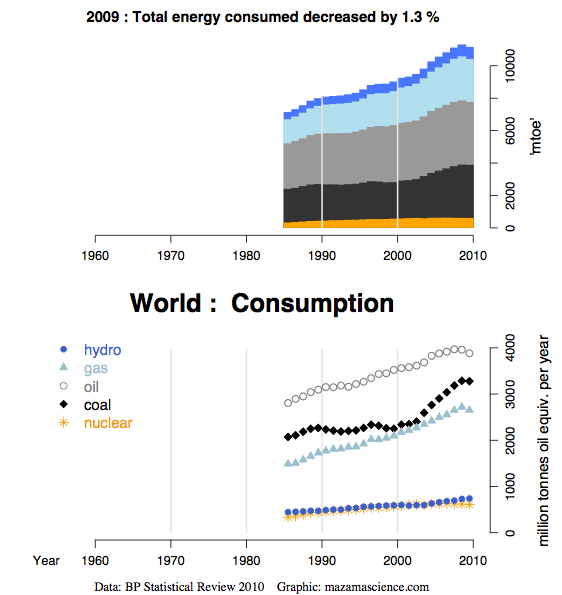

Figure 11. World energy consumption, from Energy Export Data Browser
I wonder if all of the emphasis on CO2 reduction has not exacerbated the problem. Countries that reduce their own coal use and instead rely more on imports can feel virtuous, but they also set the stage for negative impacts. By using less coal, these countries leave more coal for lesser developed countries to import. These lesser developed countries probably burn it less safely (for example, with less mercury controls) and compete with them for jobs. The developed countries can be expected to have more and more budget problems, as their tax bases erode, and the number of unemployed rises.
When new electricity generation is planned in the United States, the usual practice is to compare expected costs with other types of new electricity generation that might be possible in the United States. It seems to me that this practice does not show the full picture. Goods and services produced in the United States will have to compete with goods and services produced around the world. Some of the electricity used will be from nuclear plants that have long been paid off; some will be from coal production; and a little will be from high priced new types of electricity production. As long as there are no tariffs or other trade restrictions, higher-priced US electricity will tend to hinder exports and help imports. I would vote for trade restrictions.
Conclusion
The downslope of oil production can be expected to reflect a combination of different impacts.
Unless technology improvements truly have a huge impact, it would seem to me that the overall direction of the downslope is likely to be faster than Hubbert’s Curve would predict.
Thanks for writing!
Best Regards,
Gail Tverberg (also known as Gail the Actuary)
Thursday, May 20, 2010
Why our Financial System is Fundamentally Broken
Unhinged: When Concrete Reality No Longer Matters to the Market (and What to Do About It)
by Zeus Yiamouyiannis, Ph.D.
Introduction
Something profound has happened, obscured by all the concerns about economic details and speculation about whether we are in a “deep recession” or a “depression,” a “nascent recovery” or a “W shaped” downturn. We no longer have a global economic system that is tethered to concrete reality. Parasitic, amoral, slight-of-hand value-shuffling (what I would call the “unreal economy”) has effectively trumped the “real economy,” the production and exchange of meaningful goods and services.
Worse, we’ve let it happen with our acquiescence, our hope that we can just ride this one out, and our denial of what we sense intuitively to be true—pervasive fraud in the conduct of global financial business and massive counterfeiting in the establishment of value.
We’ve allowed big banks and affiliated institutions to simply concoct fake wealth out of thin air, and we have legitimized and rewarded these concoctions with a massive transfer of real wealth to a very small but powerful oligarchy through unregulated private bets backed by public taxpayer money, stratospheric fees siphoned from transactions, predatory lending, and private equity cannibalization of once-productive firms.
A global economy mediated by an acceptance of a standardized, reality-based rule of law and value between nations has given way to the shrouded anarchy of transnational banks as overriding powers driven by their own brand of anti-public “interest.”
What constitutes value has migrated from actual value, based in something you earn and related to something you can actually concretely use, to “references to value,” some number merely assigned to some financial instrument attached to some good or service somewhere several degrees removed from its source. (Think “mortgage backed securities” where the actual deeds to properties are no longer even in the picture after extensive “packaging” and repackaging.)
This is all a fancy way of playing the age old game, externalize liabilities, internalize gains, but on an unprecedented and potentially cataclysmic scale. Just as with political coverage that largely deals with the “horse race,” personalities, gaffes, and likeability of candidates over actual policy, financial coverage has concerned itself with a relentless boosterism, tea leaf reading, and a host of other trivialities while the structural rot goes unreported.
Abstractions like the “velocity of money,” along with whitewashing indicators like trading volume are used to gauge the health of an economy without sorting out whether such indicators are attached to some productive, underlying activity or asset. This all serves to create a convenient smoke screen for moneyed interests, and progressively makes the “new normal” one that thrusts citizens deeper into debt servitude.
Post Mortem and Review
A post mortem is in order. The elements of this worldwide con game are remarkably simple, not complex at all. Apparently you only need a few things to make a mockery of the entire global economic system, and big banks garnered these few important things through “regulatory capture”:
1) Unregulated, unenforced rules (particularly for derivatives)
2) license to “mark to model” (assign your own values to your assets)
3) ability to peg present value to irrational expected future returns (based on unlimited, exponential growth)
4) infinite leverage (no effective requirements for reserve capital in unregulated “shadow” markets)
5) massive size, so that the bank is "too big to fail" 6) non-transparency and non-accountability.
This combined with the moral, social, personal, and cultural approval of maximizing profit at any cost, incentivizes massive fraud and counterfeiting. How could this be otherwise, given the premises?
So here we have a system where you can 1) make up your own rules, 2) establish any value for any asset you choose, 3) inflate that value a hundred fold based on ostensible future value and returns, 4) leverage that inflated value another thousand or a million fold simply on your say-so, enough to buy up multi-billion dollar firms if you choose, 5) lean on taxpayer bailouts when you get into trouble, and 6) do this without any disclosure or accountability, all based upon a self-interested formula you concoct to enrich yourself. This is less sin or malfeasance than just plain lunacy. Yet, this is what we have and what we have allowed to gain the upper hand.
Literally, following the same formula with a little “solid reputation” sprinkled on, I can value my cat’s litter box at a million dollars, trade on its ostensible increased future value to skim myself a tidy sum in profit and transaction fees, leverage my “marked to model” value of that litter box, a million fold to buy up Chrysler. I can then loot Chrysler, stripping it of its real wealth and infrastructure, gut jobs, etc. for short term boosts to profits, and then walk away a billionaire.
I can give any reason or no reason at all for what I’m doing. I don’t have to tell anyone a thing, and no one is going to come after me. If they do “come after me” it will be to lard me with hundreds of billions of dollars of taxpayer money to keep the national or global economy from collapsing.
Talk about throwing good money after bad. The most I can lose is my litter box and now that everyone has a stake in the con, they have every incentive to cover it up and make me whole, both to protect against their anxiety and their feelings they’ve been conned, and to maintain a functioning dysfunctional system.
The Historical Proof
Let me stress again: This is not mere “moral hazard;” this is sheer lunacy of the highest order. Moral hazard assumes a rational framework where the “good” (productivity, efficiency, etc.) is rewarded. We have currently already established and incentivized as “rational” an irrational framework where outright, willful lying, theft, fraud, and counterfeiting are rewarded. The more parasitic and more inefficient I am in this framework, the more I make. The more I trade an asset back and forth, the more fees I get.
Even if those fees eclipse the entire value of the asset in question, I am “rationally” compelled to continue trading as long as someone else is paying. If I can inflate the value of my asset at will and pay Moody’s or Standard and Poor’s to give me a AAA rating who’s going to know?
It is sobering to contemplate that the market for unregulated derivatives alone, has exceeded the global GDP at a total volume exceeding 600 trillion dollars and possibly more than a quadrillion dollars (1,000,000,000,000,000 or a million billion dollars).
Exhibit 1: The Private Equity Tax Loophole Scam:
Joshua Kosman, author of The Buyout of America: How Private Equity Will Cause the Next Great Credit Crisis does a pretty good run-down on this scam on NPR’s November 16, 2009 “Fresh Air” .
According to the transcript, private equity firms (the new name for “leveraged buyout firms”) like the notorious Carlyle Group have purchased companies in a variety of industries and are now set to default on about a trillion dollars of their debts, close to the amount of default for the entire sub-prime mortgage market. Taking advantage of cheap money and lax lending, private equity firms will likely bankrupt about half of the 3,100 companies they bought, which currently employ one in ten American workers. Kosman estimates about 1.9 million jobs would be lost as a result.
By squeezing out workers, cutting research and development, private equity firms sell to each other at a massive short-term profit that devastates long-term viability. With the mattress industry, private equity firms bought Sealy, Simmons, and Serta. They then proceeded to essentially fix prices between themselves raising prices while lowering quality and durability. This worked short term, until competitors like Tempur-pedic gained market share and left the overpriced junk offered by their hollowed-out leveraged companies on the shelves. Market share and profitability for Serta dropped below pre-takeover levels.
The same formula is used with hospitals and other industries. Take a productive company with some reputation and loyalty, trash it, counting on lag time for people to depart, and make off with loot when it crashes.
Incredibly, going back to our theme of the market being “unhinged” from concrete reality, these private equity firms purchase companies with debt. Literally they put their fractional “money” down, and get the firm they are buying to take on the remainder of the debt! Ostensibly, since interest is tax-deductible, the reasoning goes, tax savings for the company accepting the debt will outweigh the disadvantages of paying down the interest and taking on the risks.
Of course, unsurprisingly, reality intercedes in a different direction. The scam is exposed. The equity firm walks away, and the company goes bankrupt. Many jobs are lost, and the whole country pays.
Exhibit 2: Fabricated Supply and Demand Scam: The Speculative Run-Up in Oil
Remember in the mid-2000’s when the media kept falling over itself to explain why gas prices were unhinged from oil supply and unrelated to any impinging world and seasonal events. Back then it was all explained away by mumbo-jumbo about the price of refining, and how certain refineries were off line. By 2007, the U.S. had begun a serious inquiry, with some settlements won for price fixing by retailers (the “bad apple strategy” that always leaves the big boys untouched), and, soon after, the prices settled down.
Now we have news of a new unexplained buoyancy in gas prices. This time commentators aren’t even bothering to pretend it has any rational connection with present supply and demand. Oil supplies are abundant, demand is down due to unemployed people staying home, and the summer driving season has yet to arrive. Instead prices are being “expectation driven” by speculators betting future upticks in the world economy, particularly China’s, will increase demand for oil.
The bitter irony of all this future possible value being more important than the present actual value is that this speculation could actually drive prices beyond the reach of people with less money now due to the poor economy and squash the very recovery that would give rise to legitimately higher prices in the future.
Again, a certain kind of twisted, counterproductive logic is allowed to run the market without correction from present, concrete conditions.
Exhibit 3: The Double Whammy Scam: Profiting from Designed Failure and Placing Bets Backed by Counterfeit Value
A recent government suit alleges that Goldman Sachs colluded with a billionaire short seller, John Paulson, to defraud investors and “construct a package of mortgage linked derivatives designed to blow up” so Paulson could make a fortune.
Continuing from AP reporter, Bernard Condon’s, article in the Washington Post, (Does Goldman Case Tarnish Cassandras of the Crash? April 21, 2010):
So-called short sellers, like Paulson, profit when stocks, mortgages or other assets they bet against lose value. In other words, the game of guessing which way prices would go was allegedly rigged in this case. That sounds bad enough. But some Wall Street veterans say the real tarnish on our erstwhile housing heroes is the package itself - regardless of whether it was designed to fail. By just linking to mortgages but not actually containing any, the Paulson package and others marketed by banks upped bets on housing to more than even the mortgages in existence, making the overall losses much bigger now that boom has turned to bust.
"Normally short sellers add rationality to a runaway marketplace," says Charles Smith, who oversees $1 billion at Fort Pitt Capital Group. "But in this case they were adding rocket fuel to the fire." The fuel here is devilishly difficult to understand. Called synthetic collateralized debt obligations (CDOs), these packages contained a series of wagers on whether thousands of homeowners would continue to pay their loans.
The key thing to grasp about them, and the part that explains how they magnified housing losses, is that they don't actually own any mortgages and so aren't limited by the number of such loans. Instead, these investments merely make "reference" to real mortgages to determine which side of the wager wins. (my emphases)
Did you catch that? This language confirms the divorce of concrete reality and the market: 1) “Linking to” mortgages but not containing any, 2) not actually owning any mortgages but being able to bet on them, 3) making “reference” to real mortgages to determine which side of the wager wins, 4) wagering bets not “limited” by material assets. The last point could theoretically involve an infinite number of bets and infinite returns on those bets.
This is well analyzed except for one point: The core of this dealing is deceptively simple, even if the instruments themselves are deliberately complex. Industry bettors simply concoct counterfeit value by leveraging their own abstract, self-assigned-value assets between themselves in a ping-pong ascending scale beyond the value of the underlying concrete assets.
The bet has both replaced and exceeded the thing it refers to. There is no “there” there. Real money is siphoned in fees from the “marks,” the pension funds who are told they are investing in highly rated, stable instruments, and then the U.S. taxpayer is asked to take up trillions of dollars of real debt in order to cover a counterfeit, undisclosed bidding/betting war.
Should I be able to make a “reference” to the Bank of England, or food, or oil, simply collect billions of real money if I bet right, and lose my never-there-to-begin-with counterfeit wealth if I don’t?
Who is the “house” in this casino in which someone can wage a series of bets on assets that actually exceed the value of the assets themselves? It’s always going to be the American taxpayer, the public, bailing out an unregulated, morally and financially reprehensible private market. Usually when someone says, “You really hate America,” it’s a disgruntled conservative with a chip on his shoulder.
Well, these profiteers actually make huge sums of money by destroying America, robbing it blind, and then sticking the American citizen with the check for any downside bets. Now let’s see why very little is currently being done to correct this.
One Nasty Hangover: Cultural Capture, Complicity, Rage, and Wondering When the Perps Will Walk
As with any successful “mark” in a con, the initial reaction by the abused is shame and efforts to pretend a scam did not happen. With the American people there is also more than a trace of complicity. People got high on visions of unlimited wealth and got a taste of their skyrocketing wealth, fictional and bubble-driven as it might have been. Some even used their houses as ATM’s.
This stems from a creeping and cleverly warped version of the American Dream, that we all could get wealthy without working if we were lucky or clever enough. In the orgy to get in on a “good thing,” people didn’t ask the serious question about whether this collusion was a morally, socially, and spiritually bad way to live your life, not to mention an abominable way to treat others and future generations.
Turns out the “good thing” is bad for everyone involved, even the crooks. People will begin to wake up to this as more jobs get lost and the fig leaves of fanfare-driven recovery fade into an uncomfortable reality—the United States and the world has been ripped off trillions of dollars, more than can be paid back even on the backs of overworking two-income families.
Rage is beginning to replace shame as the promises of recovery keeping meeting the stubborn reality of high unemployment, frozen lending, plunging commercial and residential real estate, skyrocketing college tuition, and expensive oil. People are beginning to wonder, “Where are the prosecutions; where is the accountability?” Why are citizens being counseled to liquidate their retirements to pay for their upside-down mortgages while corporations walk away from billion dollar real estate busts? Why is public money being used to bail out banks that engaged in purely private, unregulated betting?
Part of the answer is revealed in the case of Bradley Birkenfeld. Birkenfeld was an inside-the-inner-circle employee of the UBS, a Swiss Bank and one of the largest banks in the world. Swiss banks pride themselves on their “discretion” and privacy, a policy that allowed them to hide stolen Nazi wealth for decades.
So it’s clear that we are only talking financial and not moral “discretion.” In fact, Swiss banks continue to be a haven for tax cheats, international arms dealers, and anyone looking to park their ill-gotten gains outside the prying eyes of international law. After counseling clients including American politicians how to divert their money into UBS to avoid taxes, and even acting as a “concierge” to buy expensive objects for clients, Birkenfeld finally blew the whistle on the operation.
In interviews on CBS’s 60 minutes and Amy Goodman’s Democracy Now, Birkenfeld and his lawyer outlined the depth the corruption. From the April 15th, 2010 Democracy Now interview with Stephen Kohn, Birkenfeld’s lawyer:
Nineteen thousand American millionaires and billionaires had these offshore accounts. You had to be very wealthy to set one of these up. The government created an amnesty program, so if you voluntarily turned yourself in, you escaped any prosecution and even public exposure. No one would even know who you were. On the other hand, to Mr. Birkenfeld, who didn’t even have an account, Mr. Birkenfeld, who turned it in, he was sentenced to prison and was not offered immunity. So that’s the dichotomy.
Dichotomy indeed. There existed in UBS tens of billions of dollars of hidden, tax-dodges for the American clients alone, and all those clients got was a slap on the wrist and more “discretion” around their identities from U.S. law enforcement? UBS itself was merely fined 780 million dollars and forced to give over its names, a drop in the bucket for their almost 2 trillion dollar holdings. For all those wanting a progressive resurgence of the level playing field and the rule of law, there is little evidence of accountability to nourish one’s desire for justice. Hopes for real top-down prosecution are fading, but is there another tack the public can take?
Conclusion: A Possible Silver Lining
How can a world-wide economy unhinged from concrete reality perhaps result in positive changes (after, no doubt, a lot of pain)? The answer is fairly brief. Part of the problem involves mooring our own notions of the good life to our material subsistence and/or success. The notion that living luxuriously equals the epitome of the good life, has stunted our development and kept us infantilized, even with the many technological, artistic, social, and cultural advances we have made.
We still spend a vast majority of our time grinding out a living in so-so jobs that do not challenge us intellectually or creatively and that displace quality energy and time we could be spending with family, friends, community, and world.
We can make things, even necessities, cheaper than we ever have, yet we are spending more time working. In the 1990’s and 2000’s, productivity skyrocketed in the U.S., but real wages remained flat or declined. Now we see why. We have become debts serfs to financializers and market manipulators, who don’t even bother having a material stake in the game.
We can see two things from this if we are prepared to mature:
1) The good life, and even the economy itself, do not have to be primarily tied to material existence, and 2) We can do most if not all the things for ourselves that “experts” are being paid to do. We can decide to rent or share housing and watch each other’s kids. We can decide to drastically reduce our consumption, thus saving the environment and de-polluting our daily life. We can move our money to community banks, directly invest into microfinance, or lend to each other through “circle lending,” cutting out the big banks and brokerages.
We can help each other fortify and maintain our health through community programs and “medical tourism”, cutting out health insurance and medical industry parasites. We can set up or join intellectually and socially edifying cultural groups. In short we can exercise civil disobedience, refuse to be stooges, create our own spaces, and and recommit to spend time and energy where our true heart lies, free from the delusional temptations of a corporate-driven reason for life that has shown itself to be both conclusively abusive and unfulfilling.
In the end, they need us, and we don’t need them. This is the only “this life” we are going to have. It’s a lot more adventurous and enhancing to be a cultural creative then a debt slave. So, what are we waiting for?
copyright 2010 Zeus Yiamouyiannis. Permission to link to this essay is hereby granted to anyone who includes the author's name, copyright and the URL to this site. http://www.oftwominds.com/blogmay10/market-unhinged-from-reality05-10.html
by Zeus Yiamouyiannis, Ph.D.
Introduction
Something profound has happened, obscured by all the concerns about economic details and speculation about whether we are in a “deep recession” or a “depression,” a “nascent recovery” or a “W shaped” downturn. We no longer have a global economic system that is tethered to concrete reality. Parasitic, amoral, slight-of-hand value-shuffling (what I would call the “unreal economy”) has effectively trumped the “real economy,” the production and exchange of meaningful goods and services.
Worse, we’ve let it happen with our acquiescence, our hope that we can just ride this one out, and our denial of what we sense intuitively to be true—pervasive fraud in the conduct of global financial business and massive counterfeiting in the establishment of value.
We’ve allowed big banks and affiliated institutions to simply concoct fake wealth out of thin air, and we have legitimized and rewarded these concoctions with a massive transfer of real wealth to a very small but powerful oligarchy through unregulated private bets backed by public taxpayer money, stratospheric fees siphoned from transactions, predatory lending, and private equity cannibalization of once-productive firms.
A global economy mediated by an acceptance of a standardized, reality-based rule of law and value between nations has given way to the shrouded anarchy of transnational banks as overriding powers driven by their own brand of anti-public “interest.”
What constitutes value has migrated from actual value, based in something you earn and related to something you can actually concretely use, to “references to value,” some number merely assigned to some financial instrument attached to some good or service somewhere several degrees removed from its source. (Think “mortgage backed securities” where the actual deeds to properties are no longer even in the picture after extensive “packaging” and repackaging.)
This is all a fancy way of playing the age old game, externalize liabilities, internalize gains, but on an unprecedented and potentially cataclysmic scale. Just as with political coverage that largely deals with the “horse race,” personalities, gaffes, and likeability of candidates over actual policy, financial coverage has concerned itself with a relentless boosterism, tea leaf reading, and a host of other trivialities while the structural rot goes unreported.
Abstractions like the “velocity of money,” along with whitewashing indicators like trading volume are used to gauge the health of an economy without sorting out whether such indicators are attached to some productive, underlying activity or asset. This all serves to create a convenient smoke screen for moneyed interests, and progressively makes the “new normal” one that thrusts citizens deeper into debt servitude.
Post Mortem and Review
A post mortem is in order. The elements of this worldwide con game are remarkably simple, not complex at all. Apparently you only need a few things to make a mockery of the entire global economic system, and big banks garnered these few important things through “regulatory capture”:
1) Unregulated, unenforced rules (particularly for derivatives)
2) license to “mark to model” (assign your own values to your assets)
3) ability to peg present value to irrational expected future returns (based on unlimited, exponential growth)
4) infinite leverage (no effective requirements for reserve capital in unregulated “shadow” markets)
5) massive size, so that the bank is "too big to fail" 6) non-transparency and non-accountability.
This combined with the moral, social, personal, and cultural approval of maximizing profit at any cost, incentivizes massive fraud and counterfeiting. How could this be otherwise, given the premises?
So here we have a system where you can 1) make up your own rules, 2) establish any value for any asset you choose, 3) inflate that value a hundred fold based on ostensible future value and returns, 4) leverage that inflated value another thousand or a million fold simply on your say-so, enough to buy up multi-billion dollar firms if you choose, 5) lean on taxpayer bailouts when you get into trouble, and 6) do this without any disclosure or accountability, all based upon a self-interested formula you concoct to enrich yourself. This is less sin or malfeasance than just plain lunacy. Yet, this is what we have and what we have allowed to gain the upper hand.
Literally, following the same formula with a little “solid reputation” sprinkled on, I can value my cat’s litter box at a million dollars, trade on its ostensible increased future value to skim myself a tidy sum in profit and transaction fees, leverage my “marked to model” value of that litter box, a million fold to buy up Chrysler. I can then loot Chrysler, stripping it of its real wealth and infrastructure, gut jobs, etc. for short term boosts to profits, and then walk away a billionaire.
I can give any reason or no reason at all for what I’m doing. I don’t have to tell anyone a thing, and no one is going to come after me. If they do “come after me” it will be to lard me with hundreds of billions of dollars of taxpayer money to keep the national or global economy from collapsing.
Talk about throwing good money after bad. The most I can lose is my litter box and now that everyone has a stake in the con, they have every incentive to cover it up and make me whole, both to protect against their anxiety and their feelings they’ve been conned, and to maintain a functioning dysfunctional system.
The Historical Proof
Let me stress again: This is not mere “moral hazard;” this is sheer lunacy of the highest order. Moral hazard assumes a rational framework where the “good” (productivity, efficiency, etc.) is rewarded. We have currently already established and incentivized as “rational” an irrational framework where outright, willful lying, theft, fraud, and counterfeiting are rewarded. The more parasitic and more inefficient I am in this framework, the more I make. The more I trade an asset back and forth, the more fees I get.
Even if those fees eclipse the entire value of the asset in question, I am “rationally” compelled to continue trading as long as someone else is paying. If I can inflate the value of my asset at will and pay Moody’s or Standard and Poor’s to give me a AAA rating who’s going to know?
It is sobering to contemplate that the market for unregulated derivatives alone, has exceeded the global GDP at a total volume exceeding 600 trillion dollars and possibly more than a quadrillion dollars (1,000,000,000,000,000 or a million billion dollars).
Exhibit 1: The Private Equity Tax Loophole Scam:
Joshua Kosman, author of The Buyout of America: How Private Equity Will Cause the Next Great Credit Crisis does a pretty good run-down on this scam on NPR’s November 16, 2009 “Fresh Air” .
According to the transcript, private equity firms (the new name for “leveraged buyout firms”) like the notorious Carlyle Group have purchased companies in a variety of industries and are now set to default on about a trillion dollars of their debts, close to the amount of default for the entire sub-prime mortgage market. Taking advantage of cheap money and lax lending, private equity firms will likely bankrupt about half of the 3,100 companies they bought, which currently employ one in ten American workers. Kosman estimates about 1.9 million jobs would be lost as a result.
By squeezing out workers, cutting research and development, private equity firms sell to each other at a massive short-term profit that devastates long-term viability. With the mattress industry, private equity firms bought Sealy, Simmons, and Serta. They then proceeded to essentially fix prices between themselves raising prices while lowering quality and durability. This worked short term, until competitors like Tempur-pedic gained market share and left the overpriced junk offered by their hollowed-out leveraged companies on the shelves. Market share and profitability for Serta dropped below pre-takeover levels.
The same formula is used with hospitals and other industries. Take a productive company with some reputation and loyalty, trash it, counting on lag time for people to depart, and make off with loot when it crashes.
Incredibly, going back to our theme of the market being “unhinged” from concrete reality, these private equity firms purchase companies with debt. Literally they put their fractional “money” down, and get the firm they are buying to take on the remainder of the debt! Ostensibly, since interest is tax-deductible, the reasoning goes, tax savings for the company accepting the debt will outweigh the disadvantages of paying down the interest and taking on the risks.
Of course, unsurprisingly, reality intercedes in a different direction. The scam is exposed. The equity firm walks away, and the company goes bankrupt. Many jobs are lost, and the whole country pays.
Exhibit 2: Fabricated Supply and Demand Scam: The Speculative Run-Up in Oil
Remember in the mid-2000’s when the media kept falling over itself to explain why gas prices were unhinged from oil supply and unrelated to any impinging world and seasonal events. Back then it was all explained away by mumbo-jumbo about the price of refining, and how certain refineries were off line. By 2007, the U.S. had begun a serious inquiry, with some settlements won for price fixing by retailers (the “bad apple strategy” that always leaves the big boys untouched), and, soon after, the prices settled down.
Now we have news of a new unexplained buoyancy in gas prices. This time commentators aren’t even bothering to pretend it has any rational connection with present supply and demand. Oil supplies are abundant, demand is down due to unemployed people staying home, and the summer driving season has yet to arrive. Instead prices are being “expectation driven” by speculators betting future upticks in the world economy, particularly China’s, will increase demand for oil.
The bitter irony of all this future possible value being more important than the present actual value is that this speculation could actually drive prices beyond the reach of people with less money now due to the poor economy and squash the very recovery that would give rise to legitimately higher prices in the future.
Again, a certain kind of twisted, counterproductive logic is allowed to run the market without correction from present, concrete conditions.
Exhibit 3: The Double Whammy Scam: Profiting from Designed Failure and Placing Bets Backed by Counterfeit Value
A recent government suit alleges that Goldman Sachs colluded with a billionaire short seller, John Paulson, to defraud investors and “construct a package of mortgage linked derivatives designed to blow up” so Paulson could make a fortune.
Continuing from AP reporter, Bernard Condon’s, article in the Washington Post, (Does Goldman Case Tarnish Cassandras of the Crash? April 21, 2010):
So-called short sellers, like Paulson, profit when stocks, mortgages or other assets they bet against lose value. In other words, the game of guessing which way prices would go was allegedly rigged in this case. That sounds bad enough. But some Wall Street veterans say the real tarnish on our erstwhile housing heroes is the package itself - regardless of whether it was designed to fail. By just linking to mortgages but not actually containing any, the Paulson package and others marketed by banks upped bets on housing to more than even the mortgages in existence, making the overall losses much bigger now that boom has turned to bust.
"Normally short sellers add rationality to a runaway marketplace," says Charles Smith, who oversees $1 billion at Fort Pitt Capital Group. "But in this case they were adding rocket fuel to the fire." The fuel here is devilishly difficult to understand. Called synthetic collateralized debt obligations (CDOs), these packages contained a series of wagers on whether thousands of homeowners would continue to pay their loans.
The key thing to grasp about them, and the part that explains how they magnified housing losses, is that they don't actually own any mortgages and so aren't limited by the number of such loans. Instead, these investments merely make "reference" to real mortgages to determine which side of the wager wins. (my emphases)
Did you catch that? This language confirms the divorce of concrete reality and the market: 1) “Linking to” mortgages but not containing any, 2) not actually owning any mortgages but being able to bet on them, 3) making “reference” to real mortgages to determine which side of the wager wins, 4) wagering bets not “limited” by material assets. The last point could theoretically involve an infinite number of bets and infinite returns on those bets.
This is well analyzed except for one point: The core of this dealing is deceptively simple, even if the instruments themselves are deliberately complex. Industry bettors simply concoct counterfeit value by leveraging their own abstract, self-assigned-value assets between themselves in a ping-pong ascending scale beyond the value of the underlying concrete assets.
The bet has both replaced and exceeded the thing it refers to. There is no “there” there. Real money is siphoned in fees from the “marks,” the pension funds who are told they are investing in highly rated, stable instruments, and then the U.S. taxpayer is asked to take up trillions of dollars of real debt in order to cover a counterfeit, undisclosed bidding/betting war.
Should I be able to make a “reference” to the Bank of England, or food, or oil, simply collect billions of real money if I bet right, and lose my never-there-to-begin-with counterfeit wealth if I don’t?
Who is the “house” in this casino in which someone can wage a series of bets on assets that actually exceed the value of the assets themselves? It’s always going to be the American taxpayer, the public, bailing out an unregulated, morally and financially reprehensible private market. Usually when someone says, “You really hate America,” it’s a disgruntled conservative with a chip on his shoulder.
Well, these profiteers actually make huge sums of money by destroying America, robbing it blind, and then sticking the American citizen with the check for any downside bets. Now let’s see why very little is currently being done to correct this.
One Nasty Hangover: Cultural Capture, Complicity, Rage, and Wondering When the Perps Will Walk
As with any successful “mark” in a con, the initial reaction by the abused is shame and efforts to pretend a scam did not happen. With the American people there is also more than a trace of complicity. People got high on visions of unlimited wealth and got a taste of their skyrocketing wealth, fictional and bubble-driven as it might have been. Some even used their houses as ATM’s.
This stems from a creeping and cleverly warped version of the American Dream, that we all could get wealthy without working if we were lucky or clever enough. In the orgy to get in on a “good thing,” people didn’t ask the serious question about whether this collusion was a morally, socially, and spiritually bad way to live your life, not to mention an abominable way to treat others and future generations.
Turns out the “good thing” is bad for everyone involved, even the crooks. People will begin to wake up to this as more jobs get lost and the fig leaves of fanfare-driven recovery fade into an uncomfortable reality—the United States and the world has been ripped off trillions of dollars, more than can be paid back even on the backs of overworking two-income families.
Rage is beginning to replace shame as the promises of recovery keeping meeting the stubborn reality of high unemployment, frozen lending, plunging commercial and residential real estate, skyrocketing college tuition, and expensive oil. People are beginning to wonder, “Where are the prosecutions; where is the accountability?” Why are citizens being counseled to liquidate their retirements to pay for their upside-down mortgages while corporations walk away from billion dollar real estate busts? Why is public money being used to bail out banks that engaged in purely private, unregulated betting?
Part of the answer is revealed in the case of Bradley Birkenfeld. Birkenfeld was an inside-the-inner-circle employee of the UBS, a Swiss Bank and one of the largest banks in the world. Swiss banks pride themselves on their “discretion” and privacy, a policy that allowed them to hide stolen Nazi wealth for decades.
So it’s clear that we are only talking financial and not moral “discretion.” In fact, Swiss banks continue to be a haven for tax cheats, international arms dealers, and anyone looking to park their ill-gotten gains outside the prying eyes of international law. After counseling clients including American politicians how to divert their money into UBS to avoid taxes, and even acting as a “concierge” to buy expensive objects for clients, Birkenfeld finally blew the whistle on the operation.
In interviews on CBS’s 60 minutes and Amy Goodman’s Democracy Now, Birkenfeld and his lawyer outlined the depth the corruption. From the April 15th, 2010 Democracy Now interview with Stephen Kohn, Birkenfeld’s lawyer:
Nineteen thousand American millionaires and billionaires had these offshore accounts. You had to be very wealthy to set one of these up. The government created an amnesty program, so if you voluntarily turned yourself in, you escaped any prosecution and even public exposure. No one would even know who you were. On the other hand, to Mr. Birkenfeld, who didn’t even have an account, Mr. Birkenfeld, who turned it in, he was sentenced to prison and was not offered immunity. So that’s the dichotomy.
Dichotomy indeed. There existed in UBS tens of billions of dollars of hidden, tax-dodges for the American clients alone, and all those clients got was a slap on the wrist and more “discretion” around their identities from U.S. law enforcement? UBS itself was merely fined 780 million dollars and forced to give over its names, a drop in the bucket for their almost 2 trillion dollar holdings. For all those wanting a progressive resurgence of the level playing field and the rule of law, there is little evidence of accountability to nourish one’s desire for justice. Hopes for real top-down prosecution are fading, but is there another tack the public can take?
Conclusion: A Possible Silver Lining
How can a world-wide economy unhinged from concrete reality perhaps result in positive changes (after, no doubt, a lot of pain)? The answer is fairly brief. Part of the problem involves mooring our own notions of the good life to our material subsistence and/or success. The notion that living luxuriously equals the epitome of the good life, has stunted our development and kept us infantilized, even with the many technological, artistic, social, and cultural advances we have made.
We still spend a vast majority of our time grinding out a living in so-so jobs that do not challenge us intellectually or creatively and that displace quality energy and time we could be spending with family, friends, community, and world.
We can make things, even necessities, cheaper than we ever have, yet we are spending more time working. In the 1990’s and 2000’s, productivity skyrocketed in the U.S., but real wages remained flat or declined. Now we see why. We have become debts serfs to financializers and market manipulators, who don’t even bother having a material stake in the game.
We can see two things from this if we are prepared to mature:
1) The good life, and even the economy itself, do not have to be primarily tied to material existence, and 2) We can do most if not all the things for ourselves that “experts” are being paid to do. We can decide to rent or share housing and watch each other’s kids. We can decide to drastically reduce our consumption, thus saving the environment and de-polluting our daily life. We can move our money to community banks, directly invest into microfinance, or lend to each other through “circle lending,” cutting out the big banks and brokerages.
We can help each other fortify and maintain our health through community programs and “medical tourism”, cutting out health insurance and medical industry parasites. We can set up or join intellectually and socially edifying cultural groups. In short we can exercise civil disobedience, refuse to be stooges, create our own spaces, and and recommit to spend time and energy where our true heart lies, free from the delusional temptations of a corporate-driven reason for life that has shown itself to be both conclusively abusive and unfulfilling.
In the end, they need us, and we don’t need them. This is the only “this life” we are going to have. It’s a lot more adventurous and enhancing to be a cultural creative then a debt slave. So, what are we waiting for?
copyright 2010 Zeus Yiamouyiannis. Permission to link to this essay is hereby granted to anyone who includes the author's name, copyright and the URL to this site. http://www.oftwominds.com/blogmay10/market-unhinged-from-reality05-10.html
Monday, February 08, 2010
The Supreme Court Decision that Destroyed Democracy
Here is an excellent essay that lays out how the recent Supreme Court decision ultimately destroys the last vestages of democracy in America:
http://www.doomers.us/forum2/index.php/topic,60955.0.html
American democracy is dead. The Supreme Court recently ruled that corporations have a First Amendment Right to make unlimited campaign donations. In doing so, Court effectively drowned out the voice of the people by allowing unlimited corporate profits to pour into the election process. I was shocked. Corporations have First Amendment Rights? Forgive me for my ignorance, but I thought the First Amendment secured Rights of the citizens that formed the government, not corporations which are a creation of government.
My ignorance started at an early age, in civics class to be exact. In civics class, they taught me that our forefathers, men like Jefferson, wrote a document called the Declaration of Independence which expressed the novel idea ". . .that all men are created equal, that they are endowed by their Creator with certain unalienable Rights, that among these are Life, Liberty and the pursuit of Happiness. - That to secure these rights, Governments are instituted among "Men, deriving their just powers from the consent of the governed."
The distinction between men and corporations and their relation to government is important, because men create governments, not corporations. Corporations are created by governments. Giving corporations Constitutional rights equal to citizen rights is the antithesis of the Declaration of Independence, that Governments are created by men to protect the Rights of men against government and any of its creations. Jefferson wrote in the Declaration of Independence that Man is endowed from birth with certain unalienable Rights. He did not say corporations. Men, not corporations are arguably created by God while corporations clearly are not. Corporations are neither "born" nor endowed by their "creator" with unalienable Rights. Corporations are legal fictions created by state law.
Our forefathers and anyone with common sense would not confuse the differences between the morality of man and the souless living fiction we call a corporation. Corporations, then and now, were creatures of the state. In the United States, corporations are creatures of state law. Federal law doesn't allow for the creation of a corporation. So, whatever Rights a corporation has are determined by the law of the state in which it is incorporated. Since a corporation has no "mother" other than the state law which creates it, it has only those Rights enumerated in the statutes under which it was chartered. The Rights of a corporation are thus not endowed by a creator and are not "unalienable" as they can be taken away at any time by the state that created it. Further, not all corporations are "created" equal, some are public, some are private, some are for profit, some are not for profit. Some states give more corporate Rights and thus lawyers spend a lot of time perusing various state laws to see where it would be most beneficial to incorporate a new corporation and what type of corporation to create. The Declaration of Independence simply was not talking about corporations having unalienable Rights. It was talking about people having Rights.
The Constitution and Bill of Rights were intended to form a limited government to protect man and his unalienable Rights to Life, Liberty, and the Pursuit of Happiness from the tyranny of a government that has the power to throw him in jail, send him to war, and put him to death. Nothing was intended to protect the legal fiction we call a corporation which cannot be forced to carry a rifle into battle or put on death row. How can the First Amendment possibly be intended to allow those corporations that profit from war and running jails the Right to participate in electing officials that ultimately make the decision to go to war, order their products, sign contracts worth billions of dollars? Only living people have the First Amendment Right to participate in the election process. Why? Because it is the individual that ultimately suffers the consequences of any abuse of government power. Men and women go to war, not corporations. Men and women are buried in Arlington National Cemetary, not corporations. Men and women are the ones that go to jail, not corporations. Only those that must suffer from governmental abuse of power and not profit from it are secured the Right to vote or participate in the election process pursuant to the First Amendment.
Thus, for the US Supreme Court to hold that corporations have First Amendment Rights to participate in the election process is ludicrous and not Constitutionally based. The rights of a corporation are determined by statute and thus can be restricted by statute. The Rights of citizens, of mankind, are not. The Right of mankind to life, liberty and pursuit of happiness are given by the creator and existed before the formation of government and thus cannot be restricted by the government.
The ultimate power of a citizen is the power to vote, the Right of suffrage. It is the Right to form a government by the consent of the governed. We do this at all levels of government each election day. Each election, we form a new government and thus, so long as the Right of suffrage exist, do away with the need for the bloody revolutions of history to form a government responsive to the people. The Right to vote is the Right upon which everything in a democracy rest.
It is only through the Right to vote that a people can hope to have a moral government, one that is beholden to a morality that there is right and wrong in this world, a morality that comes from something beyond ourselves and not a morality guided corporate driven profits. If the power of the vote is diluted or taken by the government in any way, then a government of the people and by the people ceases to exist. Any hope for morality in government is lost to greed. A government corrupted by anything other than the concept of God given Rights is no longer no longer morally accountable to the people that comprise it. Thomas Paine once wrote that if the people are denied their Right of suffrage they have the Right to rebel. How could war ever be justified as being in the best interest of the people if, for example, corporations could vote? A corporation does not register for the draft. It does not suffer the pain of lost of loved ones in war. It has no fear of war. In fact, it may profit from war.
According to the Supreme Court, even though corporations have no body to kick or soul to burn in hell, even though they are creatures of state statute, corporations have a First Amendment Right to participate in the election process just like you and me. This is akin to giving them the Right to vote. It disenfranchises the voter by allowing corporations, which are not beholden to our geographic boundaries and with pocket books of billions, to participate in the political process. It allows the outside interest of corporate greed into government. The only reason corporations participate in the political process is to influence the vote, get candidates elected that further their corporate purpose. Are we to think that the plane and tank manufacturers will not jump into the political process? How much profit is made on each billion dollar bomber? How much would a corporation pay to get a Senator elected who would approve the purchase of another 100 such bombers? Does a weapons manufacturer fear going to war or profit from it? They have no skin in the game of war, only profits. I, however, do. I have kids, that could go to war. I was once a soldier. Young men registering for the draft, young men and women in service now have skin in the game of war, but how can an 18 year old compete in the political process against the deep pockets of weapons manufacturers? This is but one example. There is simply no way that the voters who live here and will be interned here can compete in the political process with the deep pockets of a corporation. Our democracy will no longer be a place of competing ideologies based on human morality, but a place of competing business interests for profit. The politics of profits will replace political morality. This ruling by the Supreme Court supplants democracy and drives a stake through its heart.
We were all shocked in the last election that it would take $20 million in campaign donations just to make a presidential candidate viable. If there is now no limit to how much a corporation can donate, and since the donors are now world-wide, how much will it take, a billion? I mean, after all, if an oil company wants the lease rights to drill off of California, how much is that worth? How much does one oil rig cost? Millions I'm sure. $20 million in campaign contributions will just be the cost of doing business. The corporations will deduct the contribution as part of the capital expenditures budget. Who needs a measly $200 campaign donation from me anymore? This idea that the door is open for corporations to compete in the political process is more novel an idea than anything Jefferson ever wrote in the Declaration of Independence. In fact, it's the antithesis of the Declaration of Independence and everything our First Amendment was designed to secure, which is the idea that governments are comprised of living and breathing people, not corporations.
The travesty doesn't stop there. In a mere stroke of the pen, the Supreme Court gave First Amendment Rights to every corporation of the world to participate in the US election process. For those who worried about closing our borders, they have just been opened in a much more dangerous way, ways that we will not be able to see and guard against. Now, the Chinese, Russians and even Bin Laden can donate unlimited funds to the candidate of their choice. Don't think so? They'll pay their couple of hundred dollars and form a new corporation right here in the US to make campaign donations.
As a lawyer, I'm not going to waste my time reading the opinion justifying this corporate takeover over American politics, which is really just the formal caisson carrying away the dead body of the American voter. I've practiced law too long to waste my time reading a nefarious court decision somehow justifying giving corporations Constitutional Rights. It won't be long before the Supreme Court gives corporations the Right to vote, and that we individuals will only be counted as 3/4 of a citizen. Citizenship means nothing anymore. I have no problem with a decision that an individual has a Right to personally donate as much as he or she wants, but a corporation? Please, and to add sin upon sin, they get to deduct the expense. Where's my personal deduction for campaign donations? Do I still get to elect on my tax return to donate $1 to the presidential campaign fund?
We have a broken government. It doesn't work anymore. The Constitution is meaningless. It's a free for all in Washington. Washington is a cesspool. There is no difference between Republicans and Democrats. Waiving the banners of liberal versus conservative is the old strategy of divide and conquer. They divide the masses while in the CONgress nothing gets done. You know why? Because they don't work for you and me. They are all working for the money makers. All that fighting you see isn't fighting over political ideology. It's simply vultures fighting over the last remaining scraps of the American pie. They will feed. We will go hungry. Proof? More Americans are on food stamps than ever. More Americans are unemployed than since the Great Depression, and all this growing poverty despite the fact that every Republican and Democratic legislature and President has spent more money than their predecessor under this idea that "trickle down economics" is good for you and me. Where's all this money going? It's not trickling down to you and me. It's going into the pockets of these bankers that get fat bonuses because their banks are too big to fail. Really? I thought this was capitalism, where good business are rewarded and poorly run businesses fail. Apparently I was lied to again, because only the individual hard working American is allowed to fail, not the big corporations. They are too important, so important, they need our tax dollars to run their businesses and pay their personal bonuses. These trillions in tax dollars are trickling down and stopping at Wallstreet to reward banks that too big to fail because they created real estate bubbles that shouldn't have been created, and then they pay themselves tax dollar bonuses for doing so, bc if they didn't get million dollar bonuses, we might not be able to hire another crook to run them. I say good, let them stand in the unemployment line like the rest of us and live on food stamps, but they don't care about my opinion, nor yours.
It's with great sadness that I, a lawyer of 17 years now, a boy raised by his own personal Atticus Finch, a boy that once swore as a paratrooper to uphold and defend a Constitution, who swore again as an attorney to uphold that same Constitution, must now confess that that same Constitution no longer acts to limit the powers of the Government, but limits instead the will of the people to govern themselves, thus allowing the government to run amok.
The Constitution was a novel idea, a novel idea to create a contract between a government and its people. It was a contract whose intent was to protect its people by defining the powers of government in a written document, and in so doing, restrict the powers of the government to encroach upon the freedoms of the people who ultimately constituted that government. It was the idea that government is of the people, by the people for the people, reduced to writing, so that the powers of that government would be restricted, preserving the rights and freedoms of the people who constituted it.
Although novel in design, the ultimate effect of having a government reduced to writing meant that ultimately the people would be forced to look to its "limited government" to interpret the Contract that attempted to limit that same government. Is it any surprise then that the Presidents created by that Constitution have issued thousands upon thousands of executive orders, an authority not expressed in the Constitution, which also have the effect of law but are never approved by Congress? Is it any surprise that the Courts have ruled taxpayers do not having standing to sue their own government? Is it any surprise that the Courts have ruled there is no duty of the police to protect its citizens? Is it any surprise that the 4th Amendment is subject now to an undeclared war on terror? That the Patriot Act and various other legislation passed in the war on terror allows domestic spying without search warrants? Is it any surprise then that banks, regulated by our government, can limit withdrawals, place holds on safety deposit boxes etc? Any surprise at legislative "earmarks"? Any surprise that Congressmen always vote themselves pay raises, won't pass campaign reform, have free healthcare and wonderful retirement plans? These unexpressed powers and benefits of government service should not come as a surprise when it is the government that interprets its own "limited" powers.
In the end, reducing the government to a written Constitution did not limit our government. It did, however, turn the idea of subsequent generations away from the idea government is by the will of the people, to the idea that they had created a limited government that would, through benevolence for its people, restrict itself.
Our forefathers and our present generation falsely assume that government, that power, can be restricted or limited by a piece of paper. Reducing to writing the idea that power can be so easily restricted only acts to restrict the ideas of the people that read and believe the false notion that power can be so easily restricted. The false belief that gov't power can be so easily limited by a written Constitution has become a yoke around the necks of generations of Americans from which the nation can be pulled by the special interest that subvert it.
http://www.doomers.us/forum2/index.php/topic,60955.0.html
American democracy is dead. The Supreme Court recently ruled that corporations have a First Amendment Right to make unlimited campaign donations. In doing so, Court effectively drowned out the voice of the people by allowing unlimited corporate profits to pour into the election process. I was shocked. Corporations have First Amendment Rights? Forgive me for my ignorance, but I thought the First Amendment secured Rights of the citizens that formed the government, not corporations which are a creation of government.
My ignorance started at an early age, in civics class to be exact. In civics class, they taught me that our forefathers, men like Jefferson, wrote a document called the Declaration of Independence which expressed the novel idea ". . .that all men are created equal, that they are endowed by their Creator with certain unalienable Rights, that among these are Life, Liberty and the pursuit of Happiness. - That to secure these rights, Governments are instituted among "Men, deriving their just powers from the consent of the governed."
The distinction between men and corporations and their relation to government is important, because men create governments, not corporations. Corporations are created by governments. Giving corporations Constitutional rights equal to citizen rights is the antithesis of the Declaration of Independence, that Governments are created by men to protect the Rights of men against government and any of its creations. Jefferson wrote in the Declaration of Independence that Man is endowed from birth with certain unalienable Rights. He did not say corporations. Men, not corporations are arguably created by God while corporations clearly are not. Corporations are neither "born" nor endowed by their "creator" with unalienable Rights. Corporations are legal fictions created by state law.
Our forefathers and anyone with common sense would not confuse the differences between the morality of man and the souless living fiction we call a corporation. Corporations, then and now, were creatures of the state. In the United States, corporations are creatures of state law. Federal law doesn't allow for the creation of a corporation. So, whatever Rights a corporation has are determined by the law of the state in which it is incorporated. Since a corporation has no "mother" other than the state law which creates it, it has only those Rights enumerated in the statutes under which it was chartered. The Rights of a corporation are thus not endowed by a creator and are not "unalienable" as they can be taken away at any time by the state that created it. Further, not all corporations are "created" equal, some are public, some are private, some are for profit, some are not for profit. Some states give more corporate Rights and thus lawyers spend a lot of time perusing various state laws to see where it would be most beneficial to incorporate a new corporation and what type of corporation to create. The Declaration of Independence simply was not talking about corporations having unalienable Rights. It was talking about people having Rights.
The Constitution and Bill of Rights were intended to form a limited government to protect man and his unalienable Rights to Life, Liberty, and the Pursuit of Happiness from the tyranny of a government that has the power to throw him in jail, send him to war, and put him to death. Nothing was intended to protect the legal fiction we call a corporation which cannot be forced to carry a rifle into battle or put on death row. How can the First Amendment possibly be intended to allow those corporations that profit from war and running jails the Right to participate in electing officials that ultimately make the decision to go to war, order their products, sign contracts worth billions of dollars? Only living people have the First Amendment Right to participate in the election process. Why? Because it is the individual that ultimately suffers the consequences of any abuse of government power. Men and women go to war, not corporations. Men and women are buried in Arlington National Cemetary, not corporations. Men and women are the ones that go to jail, not corporations. Only those that must suffer from governmental abuse of power and not profit from it are secured the Right to vote or participate in the election process pursuant to the First Amendment.
Thus, for the US Supreme Court to hold that corporations have First Amendment Rights to participate in the election process is ludicrous and not Constitutionally based. The rights of a corporation are determined by statute and thus can be restricted by statute. The Rights of citizens, of mankind, are not. The Right of mankind to life, liberty and pursuit of happiness are given by the creator and existed before the formation of government and thus cannot be restricted by the government.
The ultimate power of a citizen is the power to vote, the Right of suffrage. It is the Right to form a government by the consent of the governed. We do this at all levels of government each election day. Each election, we form a new government and thus, so long as the Right of suffrage exist, do away with the need for the bloody revolutions of history to form a government responsive to the people. The Right to vote is the Right upon which everything in a democracy rest.
It is only through the Right to vote that a people can hope to have a moral government, one that is beholden to a morality that there is right and wrong in this world, a morality that comes from something beyond ourselves and not a morality guided corporate driven profits. If the power of the vote is diluted or taken by the government in any way, then a government of the people and by the people ceases to exist. Any hope for morality in government is lost to greed. A government corrupted by anything other than the concept of God given Rights is no longer no longer morally accountable to the people that comprise it. Thomas Paine once wrote that if the people are denied their Right of suffrage they have the Right to rebel. How could war ever be justified as being in the best interest of the people if, for example, corporations could vote? A corporation does not register for the draft. It does not suffer the pain of lost of loved ones in war. It has no fear of war. In fact, it may profit from war.
According to the Supreme Court, even though corporations have no body to kick or soul to burn in hell, even though they are creatures of state statute, corporations have a First Amendment Right to participate in the election process just like you and me. This is akin to giving them the Right to vote. It disenfranchises the voter by allowing corporations, which are not beholden to our geographic boundaries and with pocket books of billions, to participate in the political process. It allows the outside interest of corporate greed into government. The only reason corporations participate in the political process is to influence the vote, get candidates elected that further their corporate purpose. Are we to think that the plane and tank manufacturers will not jump into the political process? How much profit is made on each billion dollar bomber? How much would a corporation pay to get a Senator elected who would approve the purchase of another 100 such bombers? Does a weapons manufacturer fear going to war or profit from it? They have no skin in the game of war, only profits. I, however, do. I have kids, that could go to war. I was once a soldier. Young men registering for the draft, young men and women in service now have skin in the game of war, but how can an 18 year old compete in the political process against the deep pockets of weapons manufacturers? This is but one example. There is simply no way that the voters who live here and will be interned here can compete in the political process with the deep pockets of a corporation. Our democracy will no longer be a place of competing ideologies based on human morality, but a place of competing business interests for profit. The politics of profits will replace political morality. This ruling by the Supreme Court supplants democracy and drives a stake through its heart.
We were all shocked in the last election that it would take $20 million in campaign donations just to make a presidential candidate viable. If there is now no limit to how much a corporation can donate, and since the donors are now world-wide, how much will it take, a billion? I mean, after all, if an oil company wants the lease rights to drill off of California, how much is that worth? How much does one oil rig cost? Millions I'm sure. $20 million in campaign contributions will just be the cost of doing business. The corporations will deduct the contribution as part of the capital expenditures budget. Who needs a measly $200 campaign donation from me anymore? This idea that the door is open for corporations to compete in the political process is more novel an idea than anything Jefferson ever wrote in the Declaration of Independence. In fact, it's the antithesis of the Declaration of Independence and everything our First Amendment was designed to secure, which is the idea that governments are comprised of living and breathing people, not corporations.
The travesty doesn't stop there. In a mere stroke of the pen, the Supreme Court gave First Amendment Rights to every corporation of the world to participate in the US election process. For those who worried about closing our borders, they have just been opened in a much more dangerous way, ways that we will not be able to see and guard against. Now, the Chinese, Russians and even Bin Laden can donate unlimited funds to the candidate of their choice. Don't think so? They'll pay their couple of hundred dollars and form a new corporation right here in the US to make campaign donations.
As a lawyer, I'm not going to waste my time reading the opinion justifying this corporate takeover over American politics, which is really just the formal caisson carrying away the dead body of the American voter. I've practiced law too long to waste my time reading a nefarious court decision somehow justifying giving corporations Constitutional Rights. It won't be long before the Supreme Court gives corporations the Right to vote, and that we individuals will only be counted as 3/4 of a citizen. Citizenship means nothing anymore. I have no problem with a decision that an individual has a Right to personally donate as much as he or she wants, but a corporation? Please, and to add sin upon sin, they get to deduct the expense. Where's my personal deduction for campaign donations? Do I still get to elect on my tax return to donate $1 to the presidential campaign fund?
We have a broken government. It doesn't work anymore. The Constitution is meaningless. It's a free for all in Washington. Washington is a cesspool. There is no difference between Republicans and Democrats. Waiving the banners of liberal versus conservative is the old strategy of divide and conquer. They divide the masses while in the CONgress nothing gets done. You know why? Because they don't work for you and me. They are all working for the money makers. All that fighting you see isn't fighting over political ideology. It's simply vultures fighting over the last remaining scraps of the American pie. They will feed. We will go hungry. Proof? More Americans are on food stamps than ever. More Americans are unemployed than since the Great Depression, and all this growing poverty despite the fact that every Republican and Democratic legislature and President has spent more money than their predecessor under this idea that "trickle down economics" is good for you and me. Where's all this money going? It's not trickling down to you and me. It's going into the pockets of these bankers that get fat bonuses because their banks are too big to fail. Really? I thought this was capitalism, where good business are rewarded and poorly run businesses fail. Apparently I was lied to again, because only the individual hard working American is allowed to fail, not the big corporations. They are too important, so important, they need our tax dollars to run their businesses and pay their personal bonuses. These trillions in tax dollars are trickling down and stopping at Wallstreet to reward banks that too big to fail because they created real estate bubbles that shouldn't have been created, and then they pay themselves tax dollar bonuses for doing so, bc if they didn't get million dollar bonuses, we might not be able to hire another crook to run them. I say good, let them stand in the unemployment line like the rest of us and live on food stamps, but they don't care about my opinion, nor yours.
It's with great sadness that I, a lawyer of 17 years now, a boy raised by his own personal Atticus Finch, a boy that once swore as a paratrooper to uphold and defend a Constitution, who swore again as an attorney to uphold that same Constitution, must now confess that that same Constitution no longer acts to limit the powers of the Government, but limits instead the will of the people to govern themselves, thus allowing the government to run amok.
The Constitution was a novel idea, a novel idea to create a contract between a government and its people. It was a contract whose intent was to protect its people by defining the powers of government in a written document, and in so doing, restrict the powers of the government to encroach upon the freedoms of the people who ultimately constituted that government. It was the idea that government is of the people, by the people for the people, reduced to writing, so that the powers of that government would be restricted, preserving the rights and freedoms of the people who constituted it.
Although novel in design, the ultimate effect of having a government reduced to writing meant that ultimately the people would be forced to look to its "limited government" to interpret the Contract that attempted to limit that same government. Is it any surprise then that the Presidents created by that Constitution have issued thousands upon thousands of executive orders, an authority not expressed in the Constitution, which also have the effect of law but are never approved by Congress? Is it any surprise that the Courts have ruled taxpayers do not having standing to sue their own government? Is it any surprise that the Courts have ruled there is no duty of the police to protect its citizens? Is it any surprise that the 4th Amendment is subject now to an undeclared war on terror? That the Patriot Act and various other legislation passed in the war on terror allows domestic spying without search warrants? Is it any surprise then that banks, regulated by our government, can limit withdrawals, place holds on safety deposit boxes etc? Any surprise at legislative "earmarks"? Any surprise that Congressmen always vote themselves pay raises, won't pass campaign reform, have free healthcare and wonderful retirement plans? These unexpressed powers and benefits of government service should not come as a surprise when it is the government that interprets its own "limited" powers.
In the end, reducing the government to a written Constitution did not limit our government. It did, however, turn the idea of subsequent generations away from the idea government is by the will of the people, to the idea that they had created a limited government that would, through benevolence for its people, restrict itself.
Our forefathers and our present generation falsely assume that government, that power, can be restricted or limited by a piece of paper. Reducing to writing the idea that power can be so easily restricted only acts to restrict the ideas of the people that read and believe the false notion that power can be so easily restricted. The false belief that gov't power can be so easily limited by a written Constitution has become a yoke around the necks of generations of Americans from which the nation can be pulled by the special interest that subvert it.
Friday, June 12, 2009
Why We are in Worse Circumstances Now than During the Great Depression
When I find these nuggets of analysis and wisdom, I want to share them.
Here's a good one from Charles Hugh Smith:
http://www.oftwominds.com/blogjune09/depression06-09.html
Why the Present Depression Will Be Deeper than the Great Crash of 1929
(June 4, 2009)
Galbraith's conclusions about the causes of the Great Depression point to why the current Depression will be deeper. Continuing our analysis of The Great Crash of 1929 by John Kenneth Galbraith: by understanding the causes of the Great Depression as elucidated by Galbraith, we can observe the differences between the present and 1929. These reveal why today's Depression will be even deeper than the 1929-1941 one and why today's policy "fixes" as pursued by that great student of Depression, Ben Bernanke, are fighting the last war--a Keynesian stimulus strategy doomed to catastrophic failure.
I hesitate to call this topic "important" because such announcements instantly cut my readership in half. Thus I am inclined to call this topic "edgy," "explosive" and "contrarian," all of which sound more interesting than "important" (yawn).
Galbraith begins his exploration of causes by noting that "economics does not allow final answers on these matters. But, as usual, something can be said."
First, he demolishes the notion that abundant credit caused a speculative orgy.
Here's a good one from Charles Hugh Smith:
http://www.oftwominds.com/blogjune09/depression06-09.html
Why the Present Depression Will Be Deeper than the Great Crash of 1929
(June 4, 2009)
Galbraith's conclusions about the causes of the Great Depression point to why the current Depression will be deeper. Continuing our analysis of The Great Crash of 1929 by John Kenneth Galbraith: by understanding the causes of the Great Depression as elucidated by Galbraith, we can observe the differences between the present and 1929. These reveal why today's Depression will be even deeper than the 1929-1941 one and why today's policy "fixes" as pursued by that great student of Depression, Ben Bernanke, are fighting the last war--a Keynesian stimulus strategy doomed to catastrophic failure.
I hesitate to call this topic "important" because such announcements instantly cut my readership in half. Thus I am inclined to call this topic "edgy," "explosive" and "contrarian," all of which sound more interesting than "important" (yawn).
Galbraith begins his exploration of causes by noting that "economics does not allow final answers on these matters. But, as usual, something can be said."
First, he demolishes the notion that abundant credit caused a speculative orgy.
The long-accepted explanation that credit was easy and so people were impelled
to borrow money to buy common stocks on margin is obviously nonsense. (page 169)
On numerous occasions before and since credit has been easy, and there has been
no speculation whatever. Furthermore, much of the 1928 and 1929 speculation
occured on money borrowed at interest rates which would have been considered
especially astringent.
Far more important than the rate of interest or supply of the credit is the mood. Speculation on a large scale requires a pervasive sense of confidence and optimism and conviction that ordinary people were meant to be rich. (emphasis added, CHS)
Next, Galbraith looks to the wellspring of credit which has been virtually nonexistent in our current speculative boom: savings. (Or at least domestic i.e. U.S. savings.)
Savings must also be plentiful. If savings are growing rapidly, people will
place a lower marginal value on their accumulation; they will be willing to risk
some of it against the prospect of a greatly enhanced return.
Speculative excess is somewhat self-regulating--or should be unless manipulated by the very state which is pledged to protect the economy from such excesses. Galbraith notes:
Finally, a speculative outbreak has a greater or less immunizing effect. The
ensuing collapse automatically destroys the very mood speculation requires.
Moving from the causes of speculative excess to that of Depression, Galbraith rejects a cyclical cause: "No inevitable rhythm required the collapse and stagnation of 1930-1940."
As for the business cycle--expansion of plant, credit and inventory once over-extended, requires a contraction to restore balance--Galbraith grants it viability, but he rejects it as the cause of the Depression:
Finally, the high production of the twenties did not, as some have suggested,
outrun the wants of the people. There is no evidence that their desire for
automobiles, clothing, travel. recreation or even food was sated. A depression
was not needed so that people's wants could catch up to their capacity to produce.
So then what did trigger the Great Depression? Galbraith sets aside the speculative collapse itself for a moment and digs for problems in the real economy. He begins by noting worker productivity rose by 43% between 1919 and 1929 even as wages, salaries and prices all remained comparatively stable. This enabled increasing profits, which due to the large income disparities of the era, flowed largely to the well-to-do.
What did the wealthy do with this new-found capital?
A large and increasing investment in capital goods was a principal device by
which the profits were spent. (page 175) It follows that anything that
interrupted the investment outlays--anything, indeed, which kept them from
showing the neessary rate of increase--could cause trouble.
The effect, therefore of insufficient investment--investment that failed to keep pace with the steady increase in profits--could be falling total demand reflected in turn
in falling orders and output.
As I understand this, the proximate cause was a vast income disparity which placed much of the prosperous era's profits in the hands of a small wealthy class, who then mal-invested the profits. If that isn't ringing some bells in your head, then please recall that income disparity, which fell from 1946-1970 or so, has been rising ever since. Bingo--profits flowed increasingly into the hands of a elite wealthy class who then squandered/mal-invested the vast profits, undermining the entire economy.
Galbraith then turns to the causal relations between the collapse of the speculative stock market and the ensuing Depression. Once again, Galbraith fingers income disparity: 5% of the populace garnered a full third of personal income.
This highly unequal income distribution meant that the economy was dependent on
a high level of investment or a high level of luxury consumer spending or both.
The rich cannot buy great quantities of bread. If they are to dispose of what they receive it must be luxuries or by way of investment in new plants and new projects.
As the stock market crashed, those with the most to lose--the wealthy--found their cashflow and capital massively crimped. Since the entire economy was dependent on them spending and investing freely, the economy crashed, too.
You see where this leads in terms of the 1990s-2006 boom. The stupendous profits skimmed in the great dot-com boom flowed disproportionately into a few hands, who then mal-invested the gains (in a macro context) in a completely unproductive burst of overbuilt housing and commercial real estate. The ensuing bubble drew in all those who, in Galbraith's words, believed they deserved to be rich and as those hapless speculators crashed they took the entire middle class of homeowners with them.
Galbraith also fingers two other causes of the Great Depression: Faulty corporate structure and flawed banking structure. The parallels to the present are achingly obvious; here's Galbraith's terse description:
The fact was that American enterprise in the twenties had opened its hospitable
arms to an exceptional number of promoters, grafters, swindlers, imposters and
frauds. This, in in the long history of such activities, was a kind of flood tide of corporate larceny.
As gargantuan as the flood of corporate larceny was in the 20s, the present era certainly exceeds it by a large margin.
Here is Galbraith's trenchant comment about the banking practices of the 20s:
Since the early 30s, a generation of Americans has been told, sometimes with
amusement, sometimes with indignation, often with outrage, of the banking
practices of the late 20s. In fact, many of those practices were made ludicrous
only by the depression. Loans which would have been pefectly good were made
perfectly foolish by the collapse of the value of the collateral he had posted.
The same, I fear, cannot said of the present: millions of guaranteed-to-default mortgages made to impossibly unqualified borrowers were never good nor prudent. The same can also be said of millions of auto/truck loans, millions of credit cards, millions of home equity lines of credit, etc.
Even worse, of course, the banks of the present era achieved heights of leverage via off-balance sheet derivatives, the securitization of mortgages and other financial legerdemaine that even the greediest, most venal bankers of the 20s could not even imagine.
Lastly, Galbraith blames "the dubious state of the foreign balance," i.e. the imbalance of foreign trade and flow of funds. In 1929, the problem seems to be that the U.S. was a magnet for capital inflows even as it managed a trade surplus. That imbalance doomed the global economy. Now of course we face the opposite imbalance but the same result will follow: the U.S. continues to run a staggering, unprecendented trade imbalance even as it sucks up an unprecedented share of global capital/savings.
Galbraith concludes: "Had the economy been fundamentally sound in 1929 the effect of the great stock market crash might have been small. But business in 1929 was not sound; on the contrary it was exceedingly fragile. It was vulnerable to the kind of blow it received from Wall Street."
You mean like the evaporation of $12 trillion wealth we've just experienced in the U.S.?
But the present is far more fragile and vulnerable than the U.S. economy of 1929, for the following reasons. In 1955 Galbraith could not possibly have foreseen or anticipated these current conditions:
1. A Federal government which since the "Reagan Revolution" of 1981 (e.g. don't tax and spend, just borrow and spend) has borrowed during so-called good times on a scale once reserved for rare Keynesian stimulus to combat serious recession. Thus we find ourselves at unprecedented levels of debt (comparable in terms of GDP to the entire cost of World War II) and our current Depression has barely begun.
2. A corrupt-to-the-core corporate structure riddled with bogus accounting, reliance on financial trickery for profits and misdirected/worthless regulatory oversight.
3. A banking sector of such debauchery and fraud that the excesses of the 1920s are reduced to the pranks of slighty-naughty choirboys and girls.
4. A Federal system of entitlements (Medicare, Medicaid and Social Security) which has grown far faster than the underlying economy for decades and now threatens the very solvency of the government itself, so stupendous are the future obligations.
5. A global military hegemony which costs more than all the other militarys and intelligence operations of the entire world put together. The U.S. military consumes more oil than the nation of Sweden (9 million residents).
6. An industrial, transportation and energy infrastructure that, rather than being rebuilt during the past 26 years of debt-based "prosperity," has crumbled in a long decline. Rather than invest in electrical power grids and energy-efficient transport systems, the U.S. squandered the trillions of borrowed dollars on toys, gewgaws, electronics made elsewhere, malls and commercial towers with only transient value and millions of bloated, inefficient poorly constructed homes no one needed or could afford: "assets" which were not productive at all, "assets" which are now capital traps on a scale heretofore unimaginable
7. A paucity of U.S. savings (and thus of domestic capital) with only one historical parallel: the depths of the Great Depression when unemployment was 25%.
8. A huge reliance on financial leverage, debt, borrowing and trickery for corporate profits; the U.S. exports soybeans, increasingly worthless dollars and "financial innovations" which are now exploding in economies from Ireland to India with the destructive force of superweapons. In exchange for this dubious paper, we have accepted actual tangible goods from the rest of the world.
They are now slowly waking up to the fact they've been conned on a scale few can grasp.
9. Globalization has reworked the global supply chain in an astonishingly brief period of time. As a result, the arbitrage of currencies (foreign exchange a.k.a. forex), wages, governance (less is more profitable) and environmental regulations (zero is the most profitable) have all placed advanced post-industrial economies like the U.S. at great structural disadvantages.
10. The U.S. claims to be competitive but much of this competitiveness is highly selective and thus illusory. Everything in the U.S.--labor, goods, buildings and taxes--is high-cost, overregulated (except for finance, banking and governance) and vulnerable to unpredictable lawsuits and officially sanctioned looting. Other than recent immigrants, non-U.S. employers find the workforce is often surly, unappreciative, narcissistic, entitlement-obsessed, unhealthy, poorly educated, unmotivated and more inclined to get-rich-quick schemes than actual enterprise or productivity.
The middle management labors under impossible demands to enrich stockholders next quarter and heavy turnover insures few stay in any job long enough to learn it effectively. Team cooperation is a doublespeak fraud imposed by "facilitators," creating a phony work environment where employees and managers alike pretend to care. This bogus environment breeds a looting, game-the-system mentality in which everyone is grabbing for all they can before retirement, restructuring, reassignment, resignation or getting fired.
A "quarterly profits are God" mentality reduces the workforce (even the good workers) to units of input which are pared back or hired without regard to morale or loyalty. This managerial and cultural pathology makes a mockery of worker loyalty and breeds the very qualities of distrust and "I got mine" attitude which undermines both productivity and workplace happiness.
11. Last but certainly not least, the U.S. economy is highly depedent on cheap, abundant fossil fuels--the very fuels which are in the global depletion phase, happy stories about unlimited natural gas and tar sands to the contrary.
For all these reasons, we can anticipate the Depression currently unfolding will be deeper, longer and more destructive than the Great Depression.
Let's recount the chain of events which partly parallel the Great Depression and partly diverge in meaningfully more destructive ways from that previous era:
1. The postwar income convergence (i.e the rise of the great middle class, the reduction of poverty and the relative reduction of the Plutocracy's share of national income) reverses in the early 1970s as the "true prosperity" of the postwar era ends and is replaced by income flowing increasingly to the top as stagflation, globalization and the decline of dollar gut the purchasing power of the middle class.
2. The rising productivity of the 50s and 60s slips to the flatline through the 70s and early 80s, only picking up again as computer software and hardware revolutionize the back office, sales, manufacturing, just-in-time shipping/production, etc.
3. Concurrent with this gradual return to productivity is the rise of finance as the key profit-center of corporate America. As income skews ever more heavily to the top 1%/5%, then capital (productive assets) become ever more heavily concentrated in the hands of the financial Plutocracy. The top 1% now owns some 2/3 of the nation's entire productive wealth.
4. As profits rise (from rising productivity) then the profits flow not to wages (which remain flat to down 1975-2009 for all but the top 10% professional class) but to those who own the capital.
5. As the middle class experiences a decline in their income and purchasing power (for reasons cited above: declining dollar, rising income disparity, and wages falling due to global wage arbitrage) then they turn more and more to borrowing and ever greater debt to fund what they have been brainwashed by the media to believe is "the American dream" of imported luxury goods, bloated homes, vacuous cruises, etc.
The only other mechanism available to the middle class to increase household income is for Mom/Aunt/Grandmom to enter the workforce, which she does in the tens of millions, with sociological consequences which are still unfolding.
6. This advert/media-driven desire to borrow to fund the "good life" is hugely profitable to the money-center banks, which expand rapidly into mortgage securization, derivatives and consumer credit to the point that they come to dominate corporate profits.
7. The financial Plutocracy, observing that actually producing goods is not very profitable unless you can fix prices as per ADM (Archer Daniels Midlands) or gain government subsidies and tax giveaways (oil lease depreciation, etc.) sinks its capital into the FIRE economy (finance, insurance and real estate), eschewing real-world investments as comparatively unprofitable.
Though rarely noted, this is a longstanding trait of capitalism stretching back to 1400-era Venice. When trade became less profitable than mainland farmimg, the Venetian Elite stopped funding trading and bought farms on the mainland. As a side effect, Venice ceased to be a military and trading power. But the Elite remained immensely wealthy.
8. As the tech bubble expands, middle-class investors see the Plutocracy (those with enough capital to qualify as angel investors and vulture, oops, I mean venture capital) reaping huge gains, and they enter the dot-com stock bubble buildup with a vengeance.
9. In a happy accident, the Soviet Empire collapses just as productivity begins its computer-fueled rise in the U.S. In a so-called Unipolar World in which U.S. military, political and financial influence is unrivaled, non-U.S. investors seek the relative safety and high returns (based on appreciation of the dollar) of U.S. financial instruments.
10. The dot-com bubble implodes in a speculative meltdown (dot-bomb), and retail investors (a.k.a. the middle class 401K investors) are devastated. The ephemeral wealth they once possessed, however briefly, fuels their speculative desire to get into the next get-rich-quick game, which just so happens to be "something everyone understands:" real estate and housing.
11. Having exhausted the dot-com play, Elite capital is seeking a new high-profit home. The miracles of derivatives (CDOs, credit default swaps, etc.) and securitized debt (mortgage tranches, etc.) open up vast new opportunities for leverage, off-balance sheet shenanigans and outright fraud/debauchery of credit. As chip wafer plants disappear from Silicon Valley (too dirty, too costly, etc.) then they're replaced with paper: mortgage-backed securities.
12. Sniffing gold in them thar exurban hills, the under-capitalized and over-indebted U.S. working class and middle class reach for the chalice of easy-money gold: leveraged real estate.
13. With the Federal financial regulatory agencies in a Republican/Democrat-enforced somnambulance, the coast is clear for brigands, shysters, fraudsters, con artists, liars, cheats, and assorted riff-raff in the realtor, mortgage and appraisal businesses, who all feed the ravenous maw of the money-center banks' apparently limitless appetite for real estate assets to securitize and leverage in exotic and highly profitable ways.
14. For a wonderful five years circa 2001-2006, the game is afoot and no-down-payment Jill and $100 million bonus Jack are immensely enriched. Meanwhile, the underlying real economy is becoming ever more imbalanced and ever more fragile as real production and real productivity plummet as everyone rushes to the speculative riches of exurban McMansions and malls.
15. This last best speculative leveraged bubble pops, gutting a Wall Street which had grown utterly dependent on leverage, debt, gamed/fraudulent accounting and bubbles for its rising profits.
16. Doubly devastated by the implosion of housing and their stock investments (mostly in retirement funds), the middle class faces the terrible consequences of its 26-year stupor of ever-rising debt and leverage. Alas, the Emperor's clothes are revealed as remarkably transparent.
17. Just as in the Great Depression, to its great surprise, the Elite has also suffered catastrophic losses and declines in capital and income.
18. Having borrowed and squandered trillions of dollars since 1981 on unaffordable entitlements, military misadventures and assorted worthless bridges-to-nowhere pork spending, the Federal government (The Fed and the Treasury) finds that its ability to borrow its way out of its current debt hole somewhat annoyingly limited. The rest of the world has finally caught on to the con, and Chinese university students are openly mocking Treasury Secretary Geithner's Orwellian claim of "we support a strong dollar." The miracle is that he was not pelted with tomatoes and tarred and feathered for making such absurd statements.
19. With the global media concentrated in a scant few corporate hands (less than 10), this pulling away of the curtain is deleted/excised from media coverage in a ruthless campaign of pure "green shoots" propaganda.
20. As the wheels fall off the U.S. economy and the bubbles cannot be re-inflated, fruitless attempts at holding back the tide with incantations (stop, tide, I am Obama/Geithner/Bernanke!) and loopy sand castles (the bottom is in, buy now! Green shoots are sprouting everywhere except in the real economy!) abound. Unresponsive to propaganda, the real world grinds down into a global Depression without visible end.
Is this "edgy" enough to be worthy? I hope so.
All content, HTML coding, format design, design elements and images copyright © 2009 Charles Hugh Smith, All rights reserved in all media, unless otherwise credited or noted.
Subscribe to:
Posts (Atom)